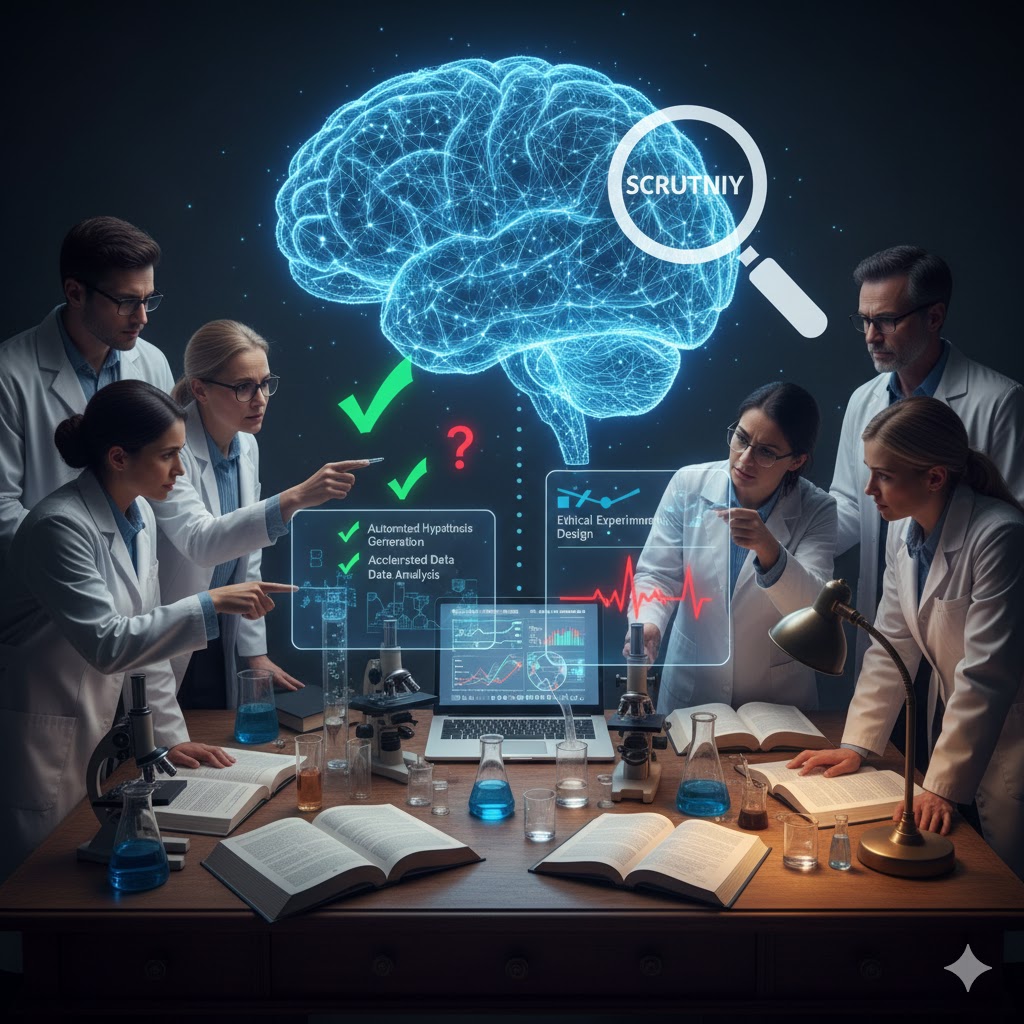

Artificial Intelligence (AI) has profoundly transformed various domains, and one of the most significant areas of impact is scientific research and methodology. However, as AI’s integration into scientific inquiry deepens, it prompts scrutiny regarding its influence on traditional scientific methods. This ongoing examination reveals essential considerations about reliability, bias, and the very nature of scientific inquiry.
Historically, scientific methods have relied heavily on hypothesis formulation, rigorous experimentation, and repeatability. AI has begun to enhance these processes by providing advanced data analysis capabilities, driving new insights from vast datasets that would be impossible for a human researcher to sift through efficiently. Machine learning algorithms can identify patterns in data, enabling researchers to formulate hypotheses that may not have been considered otherwise. This shift towards data-driven discovery signifies a departure from traditional methods, but it also raises concerns about over-reliance on algorithms whose workings may not be fully understood.
One of the critical aspects coming under scrutiny is the potential for bias in AI systems. The algorithms that power AI models are trained on historical data, which can reflect existing biases in society or flawed scientific assumptions. If researchers do not critically assess these biases, the findings generated by AI could inadvertently perpetuate inaccuracies or reinforce systemic inequalities. This situation leads to a fundamental question: Can we trust AI-generated findings without understanding the origins of its biases?
Moreover, the opacity of many AI systems complicates the reproducibility of experiments, a cornerstone of the scientific method. If results produced by AI are not easily replicable by other researchers, the reliability of AI as a scientific tool comes into question. Transparency in algorithms and data sources becomes essential to building trust in AI-driven research.
There is also a philosophical consideration of the role of creativity and intuition in science, which AI cannot replicate. While AI can enhance and optimize, it lacks the human capacity for creative thinking and ethical judgment, crucial attributes for discerning what scientific questions are worth pursuing. This raises concerns about the potential for an AI-driven approach to diminish the role of human insight in scientific discovery.
In conclusion, while AI has the potential to revolutionize scientific methods by enhancing data analysis and hypothesis generation, it also invites serious scrutiny regarding biases, reproducibility, and the diminishing role of human creativity. Ongoing dialogue among scientists, ethicists, and technologists is crucial to navigate these challenges, ensuring that as we integrate AI into science, we do so with a critical awareness of its limitations and implications. The future of scientific inquiry may very well depend on our ability to strike a balance between leveraging AI’s capabilities and upholding the foundational principles of scientific methodology.
For more details and the full reference, visit the source link below: