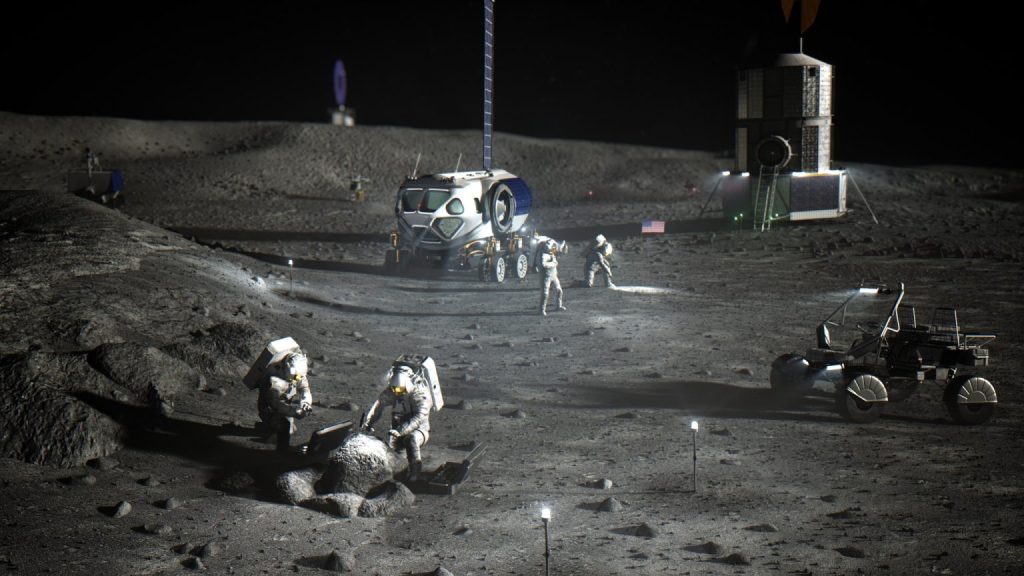

In a significant leap toward humanity’s return to the Moon, NASA’s ambitious lunar base plan is gaining momentum. The Artemis program, which aims to establish a sustainable presence on the Moon, has moved forward with revised strategies to develop a robust infrastructure capable of supporting long-term operations. The lunar base, often referred to as the Artemis Gateway, will serve as a staging area for astronauts and various scientific missions, marking a new era in space exploration.
Recent developments indicate that NASA is working closely with private contractors to accelerate the construction of this lunar outpost. Plans include habitats designed for astronauts to live and work for extended periods, laboratories for scientific research, and energy systems that harness solar power for sustainable operations. This base will allow researchers to study the lunar environment and perform experiments that would be impossible on Earth, paving the way for future missions to Mars.
A key feature of the Artemis Gateway is its capacity to facilitate international collaboration. Countries like Japan, Canada, and members of the European Space Agency are expected to contribute to this initiative, showcasing a global commitment to lunar exploration. This collaborative effort underscores the importance of shared scientific advancement and the unifying spirit of space exploration, inviting nations to participate in humanity’s journey beyond our planet.
NASA’s plans also emphasize the use of innovative technologies. The agency is prioritizing in-situ resource utilization (ISRU), which involves using local resources, such as lunar regolith, to produce essentials like water and oxygen. This technique minimizes the need to transport supplies from Earth, making lunar missions more feasible and cost-effective. By leveraging local materials for construction and fuel, a lunar base could potentially support missions to Mars and beyond.
Additionally, the Artemis program aims to address critical challenges, such as radiation exposure, extreme temperatures, and the psychological well-being of astronauts during extended missions. Research and development in these areas will ensure that future occupants of the lunar base can operate efficiently and safely in one of the most extreme environments known to humanity.
The excitement surrounding the Artemis program is palpable, as it represents a bold vision for the future of space exploration. With milestones set for the coming years, including crewed missions that will test the infrastructure of the lunar base, NASA is on a trajectory that promises to reshape our understanding of what is possible in space. The hopeful outcome of this endeavor is not just a return to the Moon, but a launchpad for humanity’s next great adventure: exploring Mars and ultimately the vast expanses of our solar system.
For more details and the full reference, visit the source link below:
Read the complete article here: https://brusselsmorning.com/nasa-lunar-base-timeline/87229/