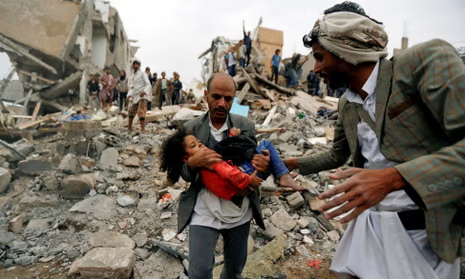

The Houthi movement, known as Ansar Allah, has become a significant player in the Yemeni conflict, engaging in a protracted struggle against the internationally recognized government backed by Saudi Arabia and a coalition of Gulf states. This conflict, which has roots tracing back to local grievances, sectarian divides, and political mismanagement, took on a broader regional context following the Arab Spring in 2011.
The Houthis, predominantly Zaydi Shia Muslims from northern Yemen, initially rose in response to perceived marginalization and neglect by the Yemeni government. Their insurgency gained momentum following the overthrow of longtime President Ali Abdullah Saleh, especially after his successor, Abdrabbuh Mansur Hadi, failed to stabilize the country. In 2014, the Houthis captured the Yemeni capital, Sana’a, further complicating the political scenario.
Saudi Arabia, viewing the Houthis as an Iranian proxy and fearing the expansion of Iranian influence in the Arabian Peninsula, intervened militarily in 2015, marking a significant escalation. The coalition, composed of Gulf Arab states, aimed to restore Hadi’s government and counteract Iran’s regional footprint. This intervention has led to a devastating humanitarian crisis, with Yemen experiencing widespread famine, disease outbreaks, and infrastructure collapse.
The conflict is characterized by various factors, including socio-economic grievances, tribal rivalries, and external geopolitical interests. The Houthis, capitalizing on the vacuum created by the lack of effective governance, have managed to establish control over substantial territory and a significant portion of the Yemeni population. Their ability to sustain military operations against a coalition with superior firepower is attributed to local support, strategic alliances, and the use of asymmetric warfare tactics.
The humanitarian impact of the conflict cannot be overstated. Millions of Yemenis face starvation, while the health infrastructure is shattered, leading to outbreaks of diseases like cholera. The UN has termed the situation as one of the worst humanitarian crises in modern history, yet the international community’s response has often been criticized as inadequate.
Efforts toward a ceasefire and political resolution have repeatedly faltered. Various negotiations, led by the United Nations, have struggled to bring the conflicting parties to a consensus, revealing the depth of the divisions and the entrenched positions. The complexity of the conflict is such that local motivations intertwine with regional power plays, making it challenging to envision a sustainable solution.
In conclusion, the Houthi-Saudi conflict in Yemen transcends mere internal politics, embodying a multifaceted struggle involving regional powers, sectarian dynamics, and profound humanitarian repercussions. The pathway to peace remains fraught with challenges, necessitating concerted efforts from both regional and international actors to forge a viable resolution.
For more details and the full reference, visit the source link below:
Read the complete article here: https://brusselsmorning.com/houthis-saudi-arabia-yemen/88213/