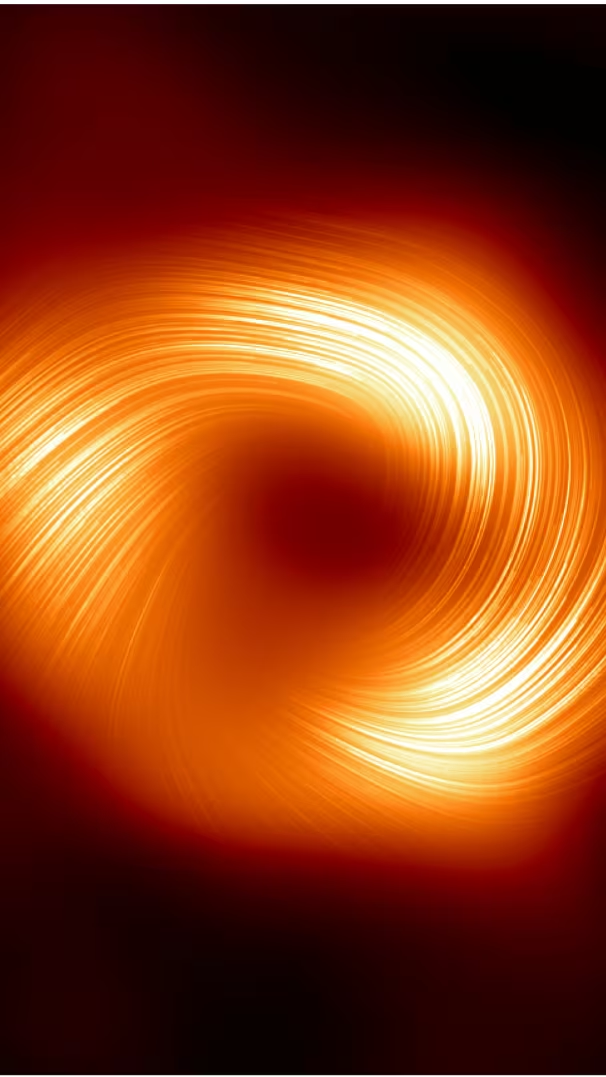

Capturing footage of a black hole in motion is a complex challenge, primarily due to the extreme distances involved and the nature of black holes themselves. Black holes, which are regions of spacetime exhibiting gravitational forces so strong that nothing—not even light—can escape from them, make direct observation impossible. However, advances in technology and astrophysics provide us with viable methods to observe and indirectly capture footage of their effects.
1. Event Horizon Telescope (EHT): The most notable attempt at observing a black hole came with the Event Horizon Telescope, a global network of radio telescopes. In 2019, EHT captured the first image of a black hole’s event horizon in the galaxy M87, demonstrating the feasibility of observing these cosmic giants. The EHT operates by combining data from multiple observatories around the world to create a virtual Earth-sized telescope, enabling it to achieve the high resolution necessary to observe details near a black hole.
2. Accretion Disks and High Energy Emissions: While a black hole itself cannot be seen, its surrounding accretion disk—a swirling mass of gas and dust that heats up and emits X-rays as it spirals in—can be observed. This high-energy emissions can be captured using space-based telescopes like the Chandra X-ray Observatory or the European Space Agency’s XMM-Newton. By observing changes in these emissions over time, astrophysicists can infer the black hole’s motion and behavior.
3. Gravitational Waves: Another groundbreaking method for observing black holes comes from detecting gravitational waves, ripples in spacetime caused by massive objects like colliding black holes. Facilities such as LIGO (Laser Interferometer Gravitational-Wave Observatory) and Virgo have shown that we can indirectly observe black hole mergers and their motion through signal analysis of these waves. The frequency and patterns help scientists glean information about their mass, spin, and movement.
4. Simulating Black Holes: Computer simulations play a critical role in predicting how black holes behave and interact with their environments. These simulations can project how the appearance of the accretion disk changes and how materials move around the black hole, giving a clearer idea of what one might capture.
5. Future Missions: Upcoming missions, such as the James Webb Space Telescope (JWST) and further advancements in multi-messenger astronomy, promise improved observational capabilities. These tools will enable researchers to capture more precise and detailed interactions involving black holes, transforming our understanding of these enigmatic phenomena.
In conclusion, while direct footage of a black hole remains unattainable, innovative techniques involving a combination of observational astronomy, gravitational wave detection, and computer simulations allow us to piece together the dynamic behavior and characteristics of black holes in our universe. Enhanced technology will continue to push the boundaries of our understanding in this fascinating field of study.
For more details and the full reference, visit the source link below: