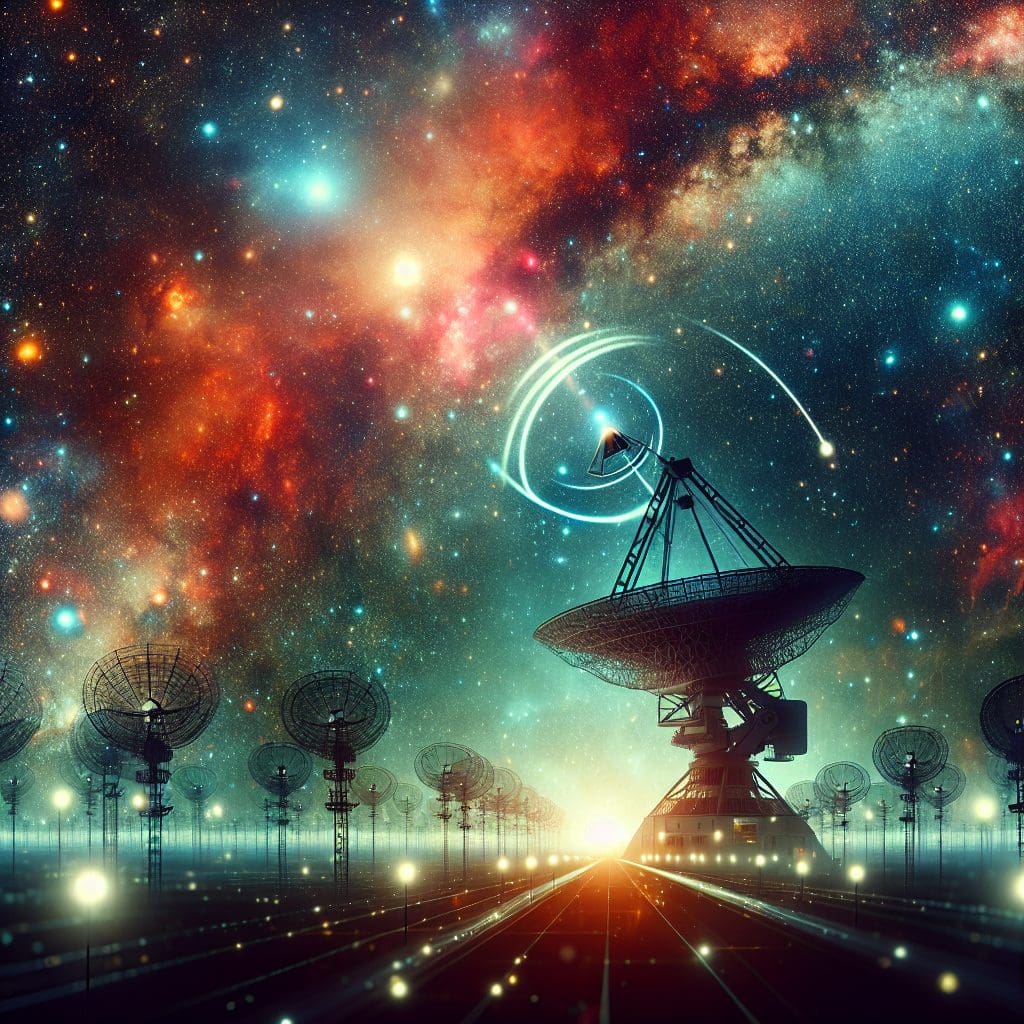

In our ongoing quest to discover extraterrestrial life, the vastness of the universe presents both opportunities and challenges. One of the most intriguing barriers we face in communicating with potential extraterrestrial civilizations is the sheer number of stars that can obscure signals. As we attempt to search the cosmos for signs of intelligent life, it is essential to consider how the universe’s structure might be complicating our efforts.
Stars emit vast amounts of light and radiation, which can overshadow weaker signals from distant civilizations. When we consider the immense distances involved in interstellar communication, even the dimmest stars can create a saturated environment where faint signals become lost. The electromagnetic spectrum, which encompasses radio waves, visible light, and other forms of radiation, is crowded with noise from various stellar phenomena. This noise can significantly impede our ability to detect the signals we might receive from extraterrestrial sources.
Moreover, the position of stars poses another hurdle. Many stars are found in densely packed areas like globular clusters, where their gravitational and electromagnetic influences can disrupt or scatter potential signals. In such environments, signals intended to travel across space may experience interference or degradation, making it challenging for us to pick them up. Furthermore, the activity of stars—such as solar flares and bursts of radiation—can also drown out signals over great distances, obscuring potential communication from another civilization.
In response to these challenges, scientists have leveraged advanced technology and methods to improve our capacity to detect extraterrestrial communications. Radio telescopes are designed to pick up weak signals, and ongoing projects like the Search for Extraterrestrial Intelligence (SETI) utilize sophisticated algorithms to filter through background noise. However, even the most cutting-edge technology has its limits, especially when faced with interference from stars.
As we look forward to future explorations, it will be crucial to not only enhance our detection methods but to also expand our understanding of star distributions and their interactions with various forms of communication. Understanding where to focus our efforts could increase our chances significantly. In a universe filled with billions of stars, we must remain vigilant, recognizing that our search is not merely a quest for habitable planets but also an effort to sift through a sea of cosmic noise. In this grand expedition, the stars, while illuminating our night sky, may simultaneously stand as the very barriers to grasping the existence of other intelligent life forms.
For more details and the full reference, visit the source link below: