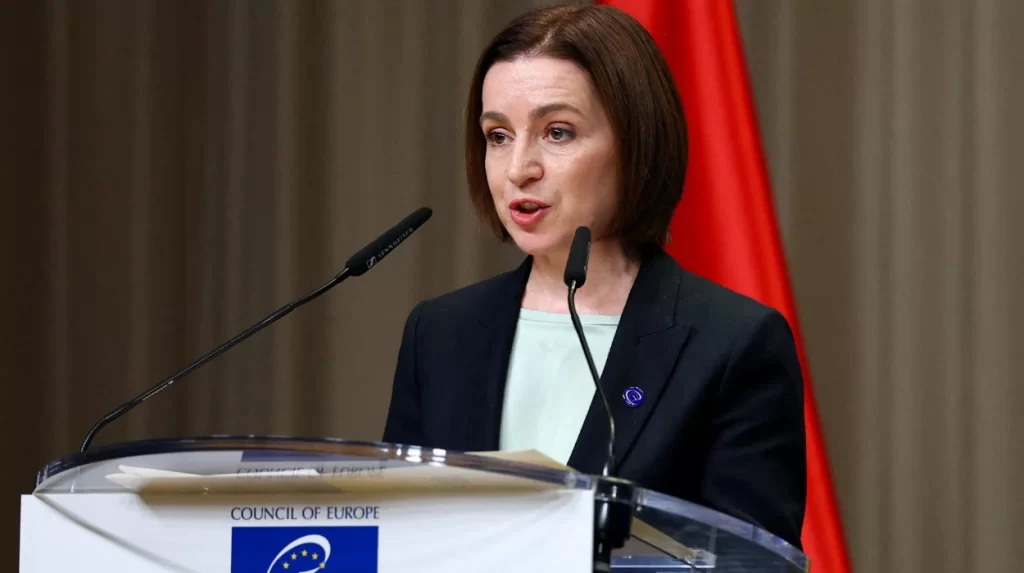

Moldovan President Maia Sandu has sparked significant attention and discourse since expressing her support for the idea of reunification with Romania. This political stance, while popular among some factions in Moldova, remains contentious, encapsulating the complex historical and cultural ties between the two nations.
Moldova and Romania share more than just a border; they share a language, cultural heritage, and a tumultuous history that includes a period when Moldova was part of Greater Romania prior to the Soviet annexation in 1940. Sandu’s reunification proposal has been interpreted as a bid to forge a closer alliance with the European Union, as Romania is a member state. Her government’s stance towards Romanian integration reflects a broader desire among some Moldovans to strengthen ties with the West, countering Russian influence in the region.
Sandu’s advocacy for reunification resonates with many Moldovans who identify culturally and linguistically with Romania. The younger generation, in particular, sees EU integration as a pathway to modernization and economic development. This perspective is often contrasted with the sentiments of pro-Russian segments of Moldovan society, who view periods of closer ties with Russia more favorably, often prioritizing historical associations over geographic proximity to Europe.
Despite Sandu’s popularity, the issue of reunification is fraught with challenges. Opposition parties, especially those supportive of Russian alignment, have criticized her position, fearing that it could lead to increased social divisions and instability within the country. They argue that Moldova’s sovereignty and independence should take precedence over unification discussions. The situation is further complicated by Transnistria, a breakaway region with a Russian military presence that complicates Moldova’s geopolitical landscape.
On the international stage, Sandu’s support for reunification has attracted varied responses. While some European leaders applaud her efforts as a step towards European integration, others caution against the potential ramifications of such moves. The broader geopolitical context, particularly concerning Russia’s stance in Eastern Europe, adds layers of complexity to these discussions.
In conclusion, President Maia Sandu’s support for reunification with Romania encapsulates a significant, albeit divisive, chapter in Moldova’s political narrative. It reflects not just a longing for a shared national identity, but also ambitions for greater European integration. As debates continue, Moldova stands at a crossroads, navigating historical legacies while seeking its place in a rapidly changing geopolitical landscape. Balancing these divergent perspectives will be crucial for the future stability and development of the nation.
For more details and the full reference, visit the source link below: