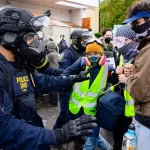

In a significant legal confrontation, the U.S. Department of Justice (DOJ) has taken a stand against Virginia’s recent legislation that imposes a ban on masks and identification requirements for federal agents operating within the state. This contentious issue reflects deeper tensions regarding state versus federal authority, particularly in an era where law enforcement dynamics are under constant scrutiny and evolving public sentiment is shaping policy.
The Virginia law, which was enacted with the intent of increasing transparency and accountability in law enforcement, has garnered criticism for potentially hindering effective policing, specifically for federal agents involved in sensitive operations. Agents often require anonymity by donning masks to protect their identities, especially in situations involving undercover work or investigations related to national security. The DOJ argues that such measures are essential for agents to effectively carry out their duties without undue risk to their safety or operational integrity.
Furthermore, the requirement for federal agents to display identification is viewed by the DOJ as an impractical mandate that could compromise sensitive missions. Federal agents, including those from the FBI, DEA, and Homeland Security, often operate in environments where the element of surprise is crucial. The potential for exposing their identities could lead to increased risks not only for the agents themselves but also for their informants and the broader public.
This legal challenge also resonates within the broader context of ongoing debates surrounding public safety and civil liberties. Supporters of the Virginia law assert that it is a necessary step towards ensuring accountability, particularly in light of heightened concerns over police conduct. Proponents believe that restricting anonymity fosters public trust, transparency, and facilitates better community-police relations. Conversely, critics argue that such restrictions could infringe upon the effectiveness and safety of federal operations, potentially hindering law enforcement’s ability to respond to emerging threats.
The courtroom battle raises pivotal questions about the scope of state authority over federal operations and the balance between civil liberties versus the operational needs of federal law enforcement. As both sides prepare to make their cases, the implications of this legal confrontation extend beyond Virginia’s borders. It could set a precedent for how states interact with federal law enforcement agencies across the nation, influencing similar laws and challenges in other states.
In conclusion, the DOJ’s challenge to Virginia’s mask and identification ban for federal agents encapsulates a complex interplay between safety, anonymity, accountability, and civil rights. As states recalibrate their policies in response to public demands for transparency, the outcome of this legal dispute could have lasting implications for the dynamics of law enforcement in America. The potential for setting a national precedent looms large, signaling a crucial juncture in the ongoing dialogue between federal authority and state legislation.
For more details and the full reference, visit the source link below: